
BLOG
- Home
- Blog
- Production & Lab
- Printing on Silicone Parts: Applications, and Printing Methods
Printing on Silicone Parts: Applications, and Printing Methods
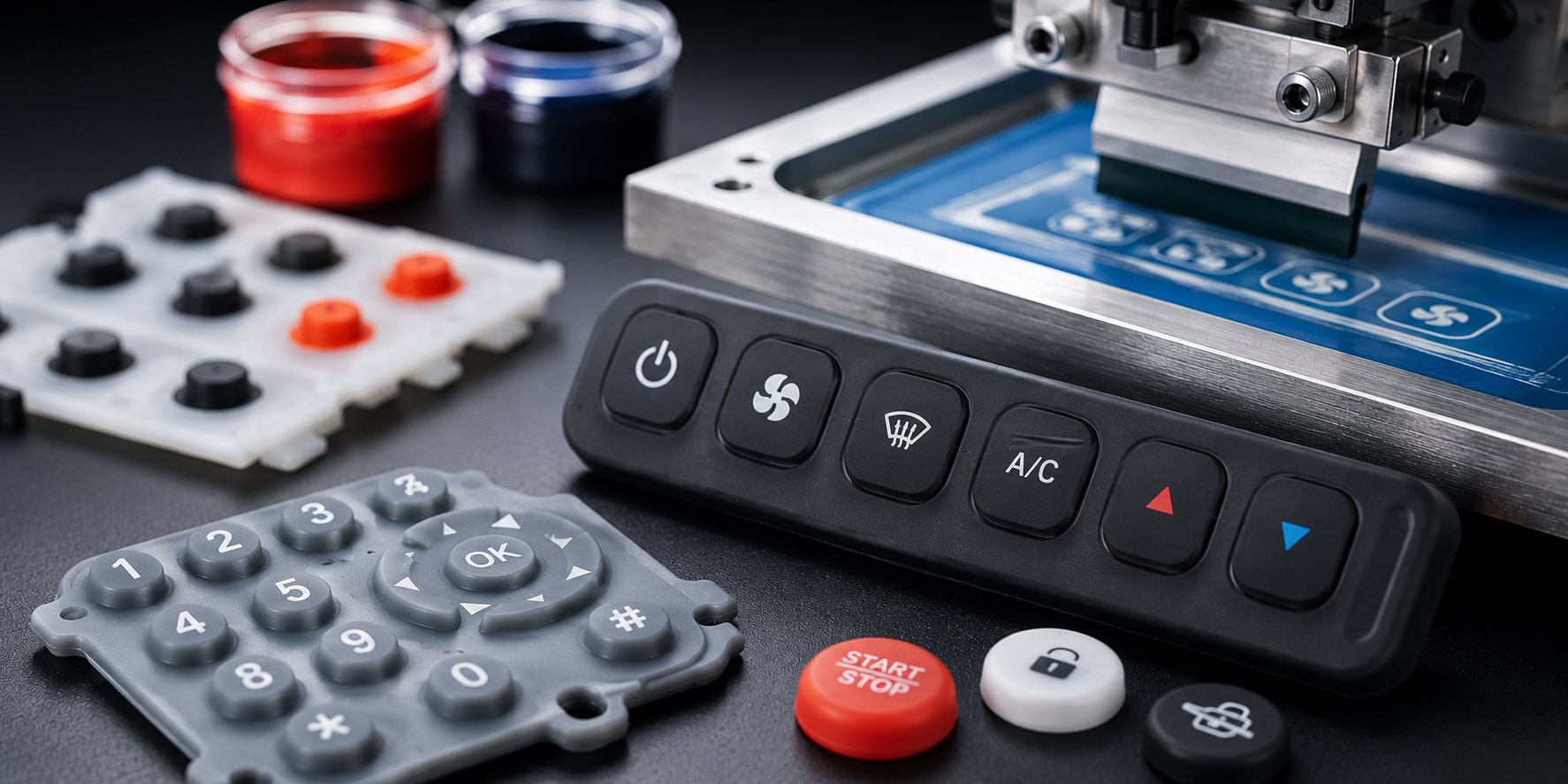
Silicone keypads, control panels, seals, and other molded silicone components are often printed with logos, icons, legends, scales, and product markings to improve product identification and user interaction. In this article, printing on silicone refers to applying graphics or text onto the surface of an already molded silicone part. It does not refer to 3D printing or additive manufacturing using silicone materials. The following sections explain common printing methods, suitable applications, ink adhesion considerations, and how to select the right surface finishing process for different product requirements.
What Is Printing on Silicone?
Printing on silicone is a post-processing technique that applies text, icons, logos, scales, or other markings onto the surface of molded silicone components. The process enhances product appearance, branding, and usability without changing the part's dimensions, structure, or mechanical properties. Depending on graphic complexity, part shape, and production volume, different printing methods and ink systems can be selected.
〈Related Articles:What You Should Know About Silicone Rubber〉
Printing on Molded Silicone Parts
A wide variety of graphics and functional markings can be printed on molded silicone parts, including keypad symbols, operating instructions, brand logos, warning labels, directional arrows, functional icons, scales, and product identification marks. These graphics are typically applied after the molding process to ensure accurate positioning and consistent appearance. From consumer electronics and medical devices to industrial controls and automotive keypads, printed silicone components improve both aesthetics and user experience.
Printing vs. Painting and Coating
Printing, painting, and coating are all common surface finishing processes for silicone products, but each serves a different purpose. Printing is used to apply logos, text, and functional graphics. Painting provides overall color coverage, light blocking, or a base layer for subsequent laser etching. Coating is applied as a protective top layer to improve wear resistance, stain resistance, and surface feel. The appropriate process depends on the required graphics, product function, and operating environment.
〈Related Articles:Painting Silicone Technology: Optimizing Color Coverage and Laser Etching Performance〉
Printing, Painting, and Coating for Silicone Parts
| Method | Main purpose | Typical use |
|---|---|---|
| Printing on Silicone | Add localized text or graphics | Logos, legends, symbols and scales |
| Silicone painting | Change the base color or block light | Full-color surfaces and preparation for laser etching |
| Silicone coating | Add a silicone protective film | Surface protection, touch and reduced dust pickup |
(Swipe left or right to view the full table.)
Printing on Silicone Methods
1. Screen Printing on Silicone
Screen printing transfers ink through a patterned mesh screen onto the surface of molded silicone parts. It is best suited for flat or gently curved surfaces and is commonly used to print text, operating symbols, logos, and larger graphic areas. The process provides excellent ink coverage, vibrant colors, and high production efficiency, making it a popular choice for silicone keypads, control panels, and industrial user interfaces.
2. Pad Printing on Silicone
Pad printing uses a flexible silicone pad to transfer ink from an engraved printing plate onto molded silicone parts. The elastic pad conforms to curved, convex, concave, and irregular surfaces, making it ideal for small graphics, fine text, logos, and precision symbols. For components with complex shapes or hard-to-reach printing areas, pad printing offers greater flexibility while maintaining excellent print quality and consistency.
Screen Printing vs. Pad Printing for Silicone Parts
| Factor | Screen Printing | Pad Printing |
|---|---|---|
| Best suited for | Flat or gently curved surfaces | Curved or irregular surfaces |
| Common graphics | Legends, larger logos, control panels | Symbols, small logos, individual keys |
| Main strength | Covers regular surfaces efficiently | Reaches complex surface geometry |
| Common use | Flat keypad areas and panels | Curved buttons and localized markings |
(Swipe left or right to view the full table.)
Applications for Printed Silicone Parts
Silicone printing is widely used on user interfaces and exterior components to add logos, symbols, text, scales, and functional markings to molded silicone parts. Since these products are frequently pressed, rubbed, cleaned, or exposed to different environments, the printing process must provide not only a clear appearance but also reliable adhesion and durability for long-term performance.
1. Silicone Keypads and Control Panels
Silicone keypads are one of the most common applications for silicone printing. Typical graphics include power icons, numeric keys, directional symbols, mode indicators, and warning marks. Screen printing is suitable for flat keypads, while pad printing is often preferred for curved or three-dimensional surfaces. For backlit products, printing can also be combined with painting and laser etching to create illuminated legends.
〈Related Articles:Behind the Scenes: Backlit Silicone Keypad Technology〉
2. Automotive and Industrial Controls
Printed silicone is widely used for steering wheel buttons, industrial control panels, equipment keypads, and instrument components. Since these parts are operated repeatedly throughout their service life, the printing must deliver excellent visibility, strong adhesion, and wear resistance to maintain clear markings over time.
〈Related Articles:Car Keypads Unpacked: Why Silicone is the Optimal Material Choice〉
3. Consumer and Healthcare Products
Printing on silicone is also common for remote controls, wearable devices, electronic accessories, and healthcare equipment. Printed graphics may include operating instructions, functional icons, or company logos. For medical-related applications, material compatibility, cleaning methods, and validation requirements should be evaluated according to each project's specifications.
〈Related Articles:Medical Grade Silicone: Definition, Applications, and Benefits〉
Typical Printing Workflow
- Artwork Review: Confirm the logo, symbols, colors, dimensions, and printing locations based on customer drawings.
- Process Selection: Choose screen printing or pad printing according to the part geometry, graphic size, production volume, and printing accuracy required.
- Surface Preparation: Clean the molded silicone part to remove contaminants or mold release residue. Additional surface treatment may be performed when necessary to improve ink adhesion.
- Printing and Curing: Apply the silicone ink and cure it under controlled conditions to achieve stable adhesion and consistent print quality.
- Inspection and Shipment: Inspect the printed graphics, alignment, color, and overall appearance. Adhesion or abrasion tests may also be conducted before shipment when required.
Printing on Silicone FQAs
What is printing on silicone?
Printing on silicone refers to adding logos, text, symbols, or markings onto the surface of an already molded silicone part. It is a post-processing operation and does not change the shape of the component itself.
Is printing on silicone the same as silicone 3D printing?
No. Printing on silicone adds graphics to an existing molded part, while silicone 3D printing builds an entire component layer by layer using silicone material. These are two completely different manufacturing processes.
What ink can be used for printing silicone parts?
Specialized silicone inks are typically required to achieve proper adhesion and durability. The ink system should be selected according to the silicone material, color requirements, and application environment.
Can Curved Silicone Surfaces Be Printed?
Yes. Screen printing may be suitable for gently curved surfaces, while pad printing is generally preferred for highly curved or irregular parts because it transfers graphics more accurately.
Can silicone printing include multiple colors?
Yes. However, each color generally requires a separate printing and curing step, so additional colors usually increase production time and manufacturing cost.
How long does printing on silicone last?
Durability depends on the ink system, curing process, operating conditions, and environment. For products subjected to frequent contact, an additional coating can be considered to improve wear resistance.
What files are needed for a custom silicone printing quote?
To prepare an accurate quotation, it is recommended to provide part drawings or 3D files, vector artwork (AI or PDF), printing locations, color requirements, silicone material, production quantity, and application details.
Custom Printing on Silicone with Glory Sun Group
The ideal silicone printing process should be selected based on part geometry, artwork, application requirements, and durability expectations. Glory Sun Group provides integrated manufacturing services, including silicone molding, printing, painting, laser etching, and coating. Backed by extensive production experience and stable manufacturing capabilities, we help customers optimize product development, improve quality, and accelerate mass production.If you require silicone printing, spray coating, laser engraving, or other customized processing services, please feel free to contact us. The Glory Sun team will help evaluate and recommend the most suitable processing method for your needs.

GSUN
GSUN has over 30 years of experience in silicone manufacturing, offering advanced technology and fully integrated in-house production from tooling to delivery. Serving automotive, medical, and industrial sectors, GSUN is ISO-certified and committed to delivering high-quality solutions and industry leadership.
Article Classification
Recent Articles
- Printing on Silicone Parts: Applications, and Printing Methods
- Painting Silicone Technology: Optimizing Color Coverage and Laser Etching Performance
- Comprehensive Guide to Silicone Gaskets: Material Properties, Applications, and Design Essentials
- How to Choose a High-Quality Silicone Manufacturer? 4 Key Evaluation Factors + A Complete Guide to the Collaboration Process
- Is compression molding recommended? Three directions to take you in-depth understanding.