
ブログ
Custom Silicone Guide: Products, Materials & Manufacturer Selection
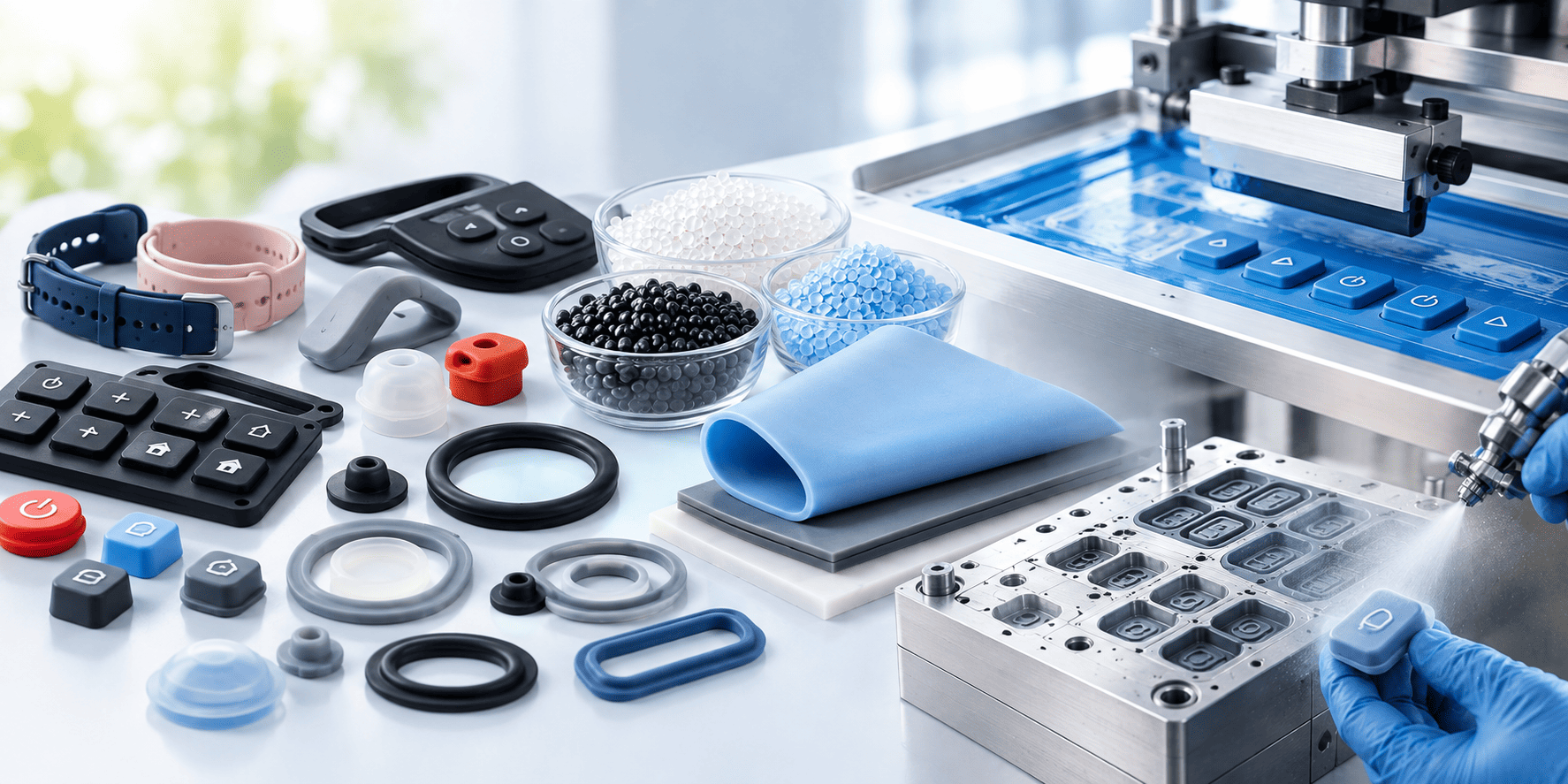
Custom silicone products can be designed according to specific product requirements, including size, shape, hardness, color, and material properties. They are widely used in automotive, medical, electronics, consumer products, and industrial equipment. From silicone keypads and seals to waterproof protective components, each application may require a different material and manufacturing process. This article introduces common applications, material selection, manufacturing methods, and key factors to consider when choosing a custom silicone manufacturer.
Material selection has a direct impact on the performance, manufacturing process, and service life of custom silicone products. The decision should not be based on material cost alone. Key factors include operating temperature, contact environment, frequency of use, hardness, mechanical properties, and safety requirements. For special applications, specific industry or customer material requirements may also need to be considered.
Since 2002, GSUN has specialized in silicone product manufacturing, with experience in both liquid silicone and solid silicone molding. The company integrates tooling, product development, and mass production capabilities to provide customized manufacturing based on customer drawings and specifications. Our products are used in automotive, medical, electronics, consumer products, and industrial applications. With relevant quality management and industry certifications, GSUN provides support throughout product development, tooling, trial molding, and mass production to help customers find the right Custom Silicone material and manufacturing solution.
What Industries Use Custom Silicone Products?
Custom silicone products can be designed according to the operating environment, product function, and quality requirements of different industries. Automotive applications often require heat resistance, weather resistance, and long-term stability, while medical products place greater emphasis on material safety and cleanliness. Electronics and lifestyle products may require flexibility, insulation, waterproofing, or dust protection. Industrial equipment often requires resistance to temperature changes, wear, and sealing performance.Automotive Industry
Silicone is widely used in automotive applications such as door control panels, instrument touch controls, overhead console controls, steering wheel controls, and buttons for center consoles, sunroofs, navigation systems, and air conditioning. Automotive components may be exposed to high temperatures, low temperatures, and repeated temperature changes, so the material needs good heat and weather resistance. Silicone also provides flexibility and resilience, making it suitable for frequently operated buttons and sealing components. Printing, painting, and laser etching can also be added according to the product design.Medical & Healthcare
Custom silicone products are also used in medical and healthcare applications, including pulse oximeter and blood pressure monitor buttons, diagnostic equipment components, protective covers, waterproof and dustproof seals, and certain orthodontic products. In these applications, material selection should be based on the actual method of contact and intended use. Products that come into contact with the human body, food, or medical environments may require specific material properties, cleanliness levels, and regulatory compliance. Material certifications and test reports should be confirmed with the manufacturer.Electronics and Lifestyle Products
Custom silicone is commonly used in electronics and lifestyle products, including payment devices, home appliance buttons, wearable components, ear tips, phone cases, and sports accessories. Silicone can also be used for waterproof and dustproof covers for USB ports and other openings. Depending on the product requirements, hardness, color, surface feel, and appearance can be customized. Silicone's flexibility, electrical insulation, and resilience also make it suitable for applications requiring cushioning, protection, pressing, and sealing functions.Industrial Instruments
In industrial instruments and equipment, silicone can be used for buttons and components in digital meters, voltage testers, electrical monitoring equipment, and flow meters. Other applications include vibration cushions, silicone caps, O-rings, waterproof seals, and oil seals. Since these components may operate continuously for long periods, the silicone material should be selected according to the actual environment, including temperature changes, oils, chemicals, wear, and moisture. Proper material and product design can improve sealing, insulation, and long-term reliability.How Are Custom Silicone Products Made?
Custom silicone products are designed according to product drawings, operating conditions, and performance requirements. Dimensions, shapes, hardness, colors, and material properties can all be customized. During manufacturing, the molding process should be selected according to the product structure, dimensional requirements, functions, and expected production volume. Common silicone manufacturing methods include Liquid Silicone Injection Molding, Compression Molding, and Silicone Overmolding.Liquid Silicone Injection Molding
Liquid Silicone Injection Molding uses two-component Liquid Silicone Rubber (LSR), which is mixed and injected into a heated mold before curing into the final shape. LSR offers good flowability and is suitable for precision components, complex structures, and small silicone parts. The process is also suitable for automated mass production with stable quality. Common applications include medical devices, electronic components, automotive parts, silicone keypads, and baby products.
Compression Molding
Compression Molding places pre-formed solid silicone material into a mold, where heat and pressure are applied to form the final product. Compared with Liquid Silicone Injection Molding, the process is more straightforward and can be suitable for larger or relatively simple components. Compression molding is a well-established manufacturing method and is widely used for silicone gaskets, seals, keypads, and various rubber components.Insert Molding
Insert Molding is a manufacturing process in which a metal, plastic, or other pre-formed insert is positioned and secured inside a mold before silicone is molded around it. This allows different materials to be integrated into a single component and can reduce the need for additional assembly processes. Insert Molding is suitable for products that require metal terminals, threaded components, electronic components, or other structural inserts to be combined with silicone. It is commonly used in automotive, electronics, industrial, and consumer products.Over molding
Silicone over molding is a manufacturing process in which a finished plastic substrate is placed into a mold and then over molded with silicone to form an integrated structure. By combining the properties of plastic and silicone, the process can add sealing, anti-slip, cushioning, insulation, or soft-touch functions to plastic components. It is suitable for products that require both structural support and the functional properties of silicone. During development, the plastic substrate, silicone material, product structure, and bonding method between the two materials should be carefully evaluated.Custom Silicone Manufacturing Methods Comparison
|
製造方式 |
適合產品 |
主要特點 |
|
Liquid Silicone Injection Molding |
Complex, precision parts for mass production |
High precision and high production efficiency |
|
Compression Molding |
Simple and larger silicone parts |
Mature process and easier cost control |
|
|
Products that require metal, plastic, or electronic components to be integrated |
Reduces assembly and improves component integration |
|
Over molding |
Products that combine a plastic substrate with silicone functions |
Adds sealing, anti-slip, cushioning, or insulation functions |
How to Choose Materials for Custom Silicone?
Material selection has a direct impact on the performance, manufacturing process, and service life of custom silicone products. The decision should not be based on material cost alone. Key factors include operating temperature, contact environment, frequency of use, hardness, mechanical properties, and safety requirements. For special applications, specific industry or customer material requirements may also need to be considered.Operating Temperature and Environment
Before selecting a silicone material, it is important to identify both the long-term operating temperature and any short-term temperature exposure. Other factors should also be considered, including UV exposure, ozone, oils, cleaning agents, chemicals, and high humidity. Different silicone materials offer different levels of environmental resistance, so the material should be selected according to the actual application. For demanding environments, material testing during the development stage is recommended.Hardness and Mechanical Properties
Silicone hardness affects flexibility, pressing feel, support, and sealing performance, so the appropriate hardness should be selected according to the product function. In addition to Shore A hardness, properties such as tensile strength, tear strength, resilience, and compression set should also be considered. For example, seals may require good recovery and compression performance, while keypads may focus more on pressing feel and return force.Safety and Compliance Requirements
When silicone products come into direct or indirect contact with food, the human body, or medical environments, applicable safety and regulatory requirements should be confirmed. Medical products may require specific medical-grade materials and testing, while food-contact products may need to meet applicable food-contact regulations. Material selection should not be based only on terms such as “food grade” or “medical grade.” Material specifications, certificates, test reports, and intended applications should be confirmed with the manufacturer.How to Choose a Custom Silicone Manufacturer?
After confirming the material requirements, the next step is choosing the right silicone manufacturer. In addition to price, companies should evaluate silicone materials, molding capabilities, tooling, quality certifications, and relevant industry experience. Custom products often require close communication throughout development, making engineering support an important factor. A manufacturer with integrated in-house capabilities can also provide better control over production, quality, and lead times.Communication and Lead Time Management
Custom silicone projects usually involve several stages, including drawing review, material evaluation, quotation, tooling, trial production, sample approval, and mass production. Communication efficiency can therefore have a direct impact on the overall development schedule. When selecting a manufacturer, it is useful to check whether there is a clear project contact and whether each development stage has a defined timeline. Fast communication on drawing or material changes can help reduce misunderstandings and avoid delays in tooling, production, or delivery.In-House Tooling and Production
When a manufacturer can handle tooling, trial molding, production, and subsequent processing in-house, communication between different suppliers can be reduced. This can be particularly helpful during custom product development. If dimensional, structural, or molding adjustments are required after a trial, an in-house tooling team can usually respond and make changes more efficiently. Managing tooling and mass production within the same organization also helps maintain consistent production conditions and product quality.Quality Certifications and Industry Experience
When evaluating a silicone manufacturer, companies should check whether the manufacturer holds relevant quality management certifications, such as ISO 9001, ISO 13485, or IATF 16949, depending on the application. Industry experience is also important, particularly in automotive, medical, consumer products, and industrial equipment. Different industries have different requirements for materials, dimensions, cleanliness, and quality control. Certifications are important, but actual production experience and quality management practices should also be considered.
Custom Silicone Manufacturer Recommendation:GSUN
Since 2002, GSUN has specialized in silicone product manufacturing, with experience in both liquid silicone and solid silicone molding. The company integrates tooling, product development, and mass production capabilities to provide customized manufacturing based on customer drawings and specifications. Our products are used in automotive, medical, electronics, consumer products, and industrial applications. With relevant quality management and industry certifications, GSUN provides support throughout product development, tooling, trial molding, and mass production to help customers find the right Custom Silicone material and manufacturing solution.Conclusion
Custom Silicone products can be customized in terms of dimensions, structure, hardness, color, material, and molding process to meet specific product requirements. From automotive and medical components to electronics and industrial equipment, different applications require different material and manufacturing solutions. When developing a custom silicone product, it is important to work with a manufacturer that has experience in tooling, molding, and mass production. If you are looking for a custom silicone manufacturing solution, please contact GSUN with your product drawings and specifications. Our engineering team can help evaluate the appropriate material, manufacturing process, and production solution.

GSUN
GSUNはシリコーン製造において30年以上の経験を持ち、高度な技術と、金型製作から納品までを自社で完全に統合した生産体制を提供しています。自動車、医療、産業分野にサービスを提供するGSUNは、ISO認証を取得しており、高品質なソリューションの提供と業界におけるリーダーシップの確立に尽力しています。